

When building systems fail, the default response is often replacement. Tear it out, start fresh, and accept the disruption as the cost of progress.
At U.S. Engineering Service, we have learned that the most effective solutions often come from asking a different question: What can be restored, optimized, and future-proofed without unnecessary demolition?
A recent retrofit at Wichita State University illustrates how that mindset delivers control, flexibility, and long-term value while keeping critical spaces operational.
Diagnose First. Replace Only What’s Necessary.
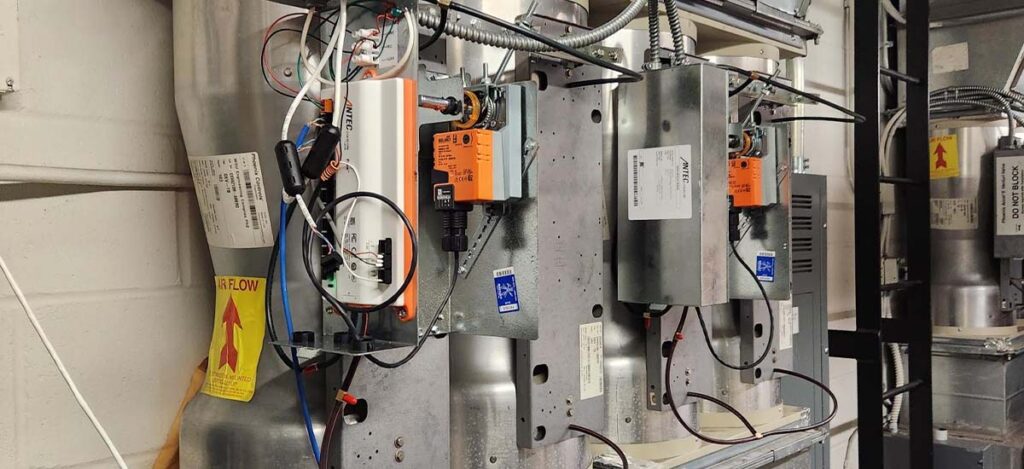
Wichita State University was dealing with a loss of control in one of its campus buildings. Valves were failing, actuators were not responding, and the system had fallen out of building automation entirely. Airflow could not be monitored, and the work happening inside the building was increasingly difficult to support.
Rather than defaulting to wholesale replacement, our team assessed the system holistically. The issue was not the entire infrastructure. It was failed internal components and lost connectivity. By rebuilding the valves and restoring automation, we returned full system control while preserving existing ductwork and minimizing disruption.
That approach reduced demolition, shortened the schedule, and kept the building operational throughout the project.
Integrated Teams, Faster Problem Solving
One differentiator in retrofit work is how quickly teams can respond when conditions change. On this project, all work stayed in-house, including field teams, testing and balancing, and controls.
Our Kansas City testing and balancing team managed airflow adjustments, and when controls challenges surfaced, controls specialist Dylin Liles remoted in to fine-tune system performance in real time. That integration eliminated handoffs, reduced delays, and allowed issues to be resolved as they arose rather than after the fact.
Designing for the Unknown
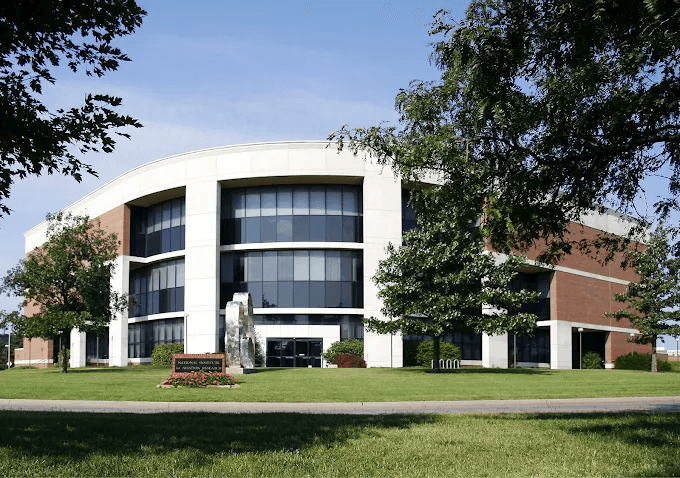
The building is occupied by NIAR, the National Institute for Aviation Research, where lab configurations and airflow needs can change. Usage details are not always available in advance. That uncertainty made room-to-room balancing more complex, but it also reinforced the project’s core objective. Restore control at the system level so the university can adapt as needs evolve.
By repairing the valves and reconnecting the building to automation, Wichita State gained visibility and flexibility. These are tools that matter far beyond the scope of a single retrofit.
Execution That Respects the Environment
Retrofit work succeeds or fails in the details. Some valves were located 30 feet above the floor and surrounded by immovable CNC equipment. Our team sequenced the work in four carefully planned phases to maintain lab operations while accessing challenging spaces safely and efficiently.
The result was a smooth installation, minimal disruption, and a system that performs as intended.
The Bigger Takeaway
This project was not just about fixing valves. It was about restoring control, avoiding unnecessary replacement, and helping a campus plan smarter for the future.
Since completion, Wichita State has asked us to explore similar upgrades in an adjacent building. That follow-on work reinforces the value of a measured, diagnostic-first approach to retrofit projects.
When systems fail, replacement is not the only answer. Sometimes, the smarter path forward is knowing what to preserve, what to improve, and how to build flexibility into what already exists.